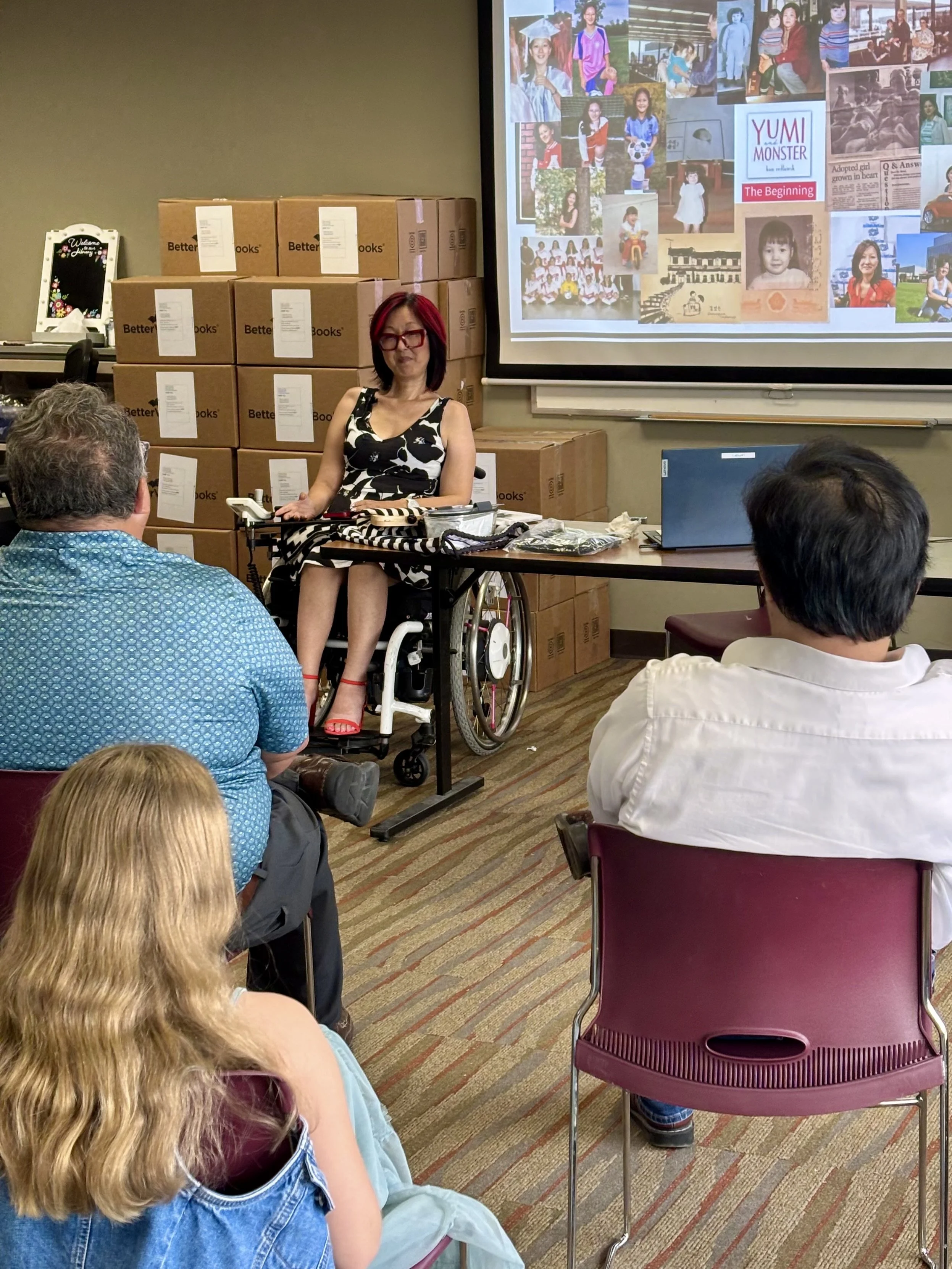
Part 1. This California girl flew to her Michigan hometown to read her first children’s book as the author AND illustrator, at her childhood library!
An overdue post about sharing over the summer my picture book, Yumi and Monster, inspired by my progressive disability, to a full house of friends, fam, locals, and followers in the town I grew up in; a perfect way to celebrate and wrap up Yumi and Monster’s first trip around the sun.
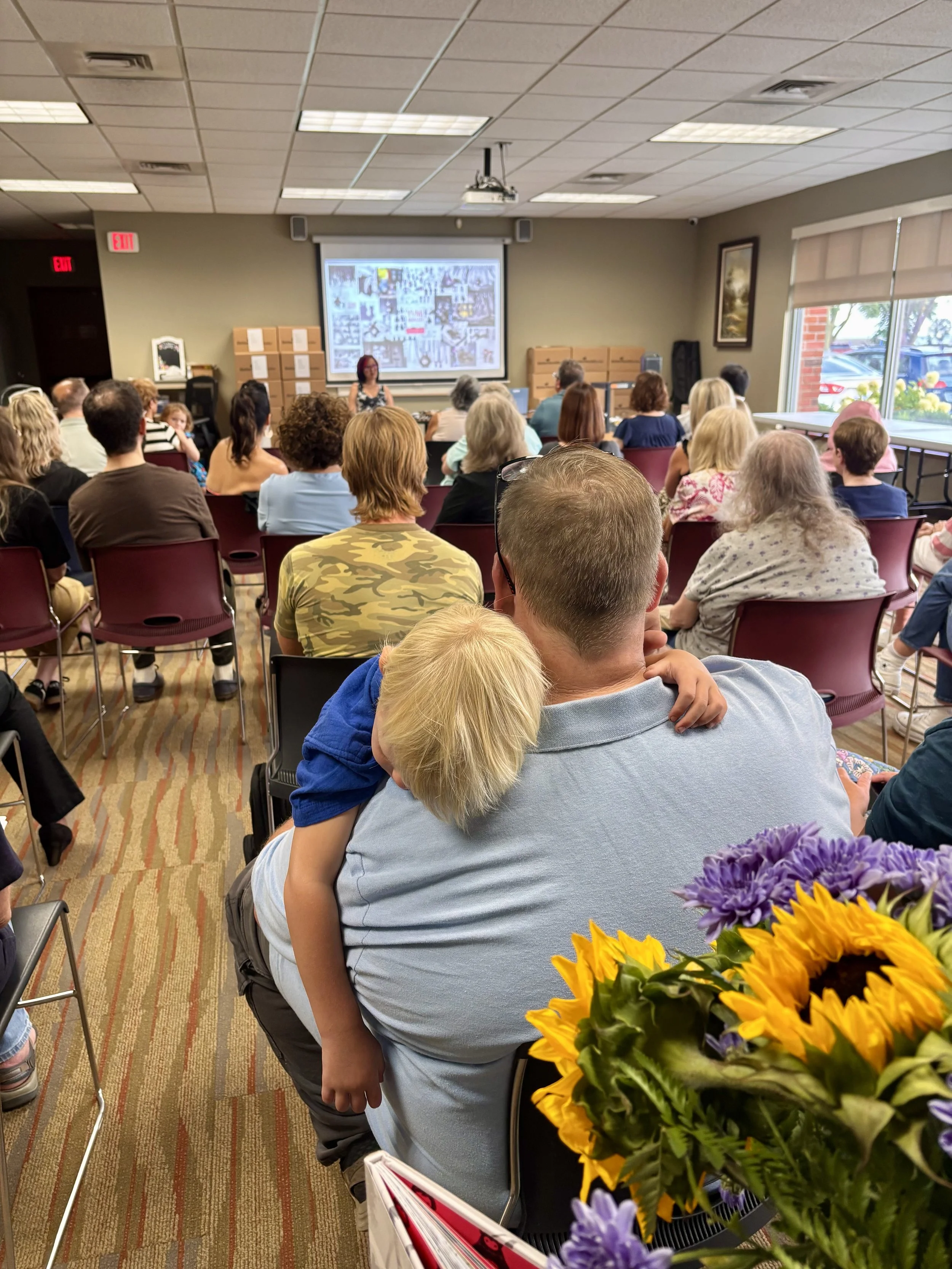
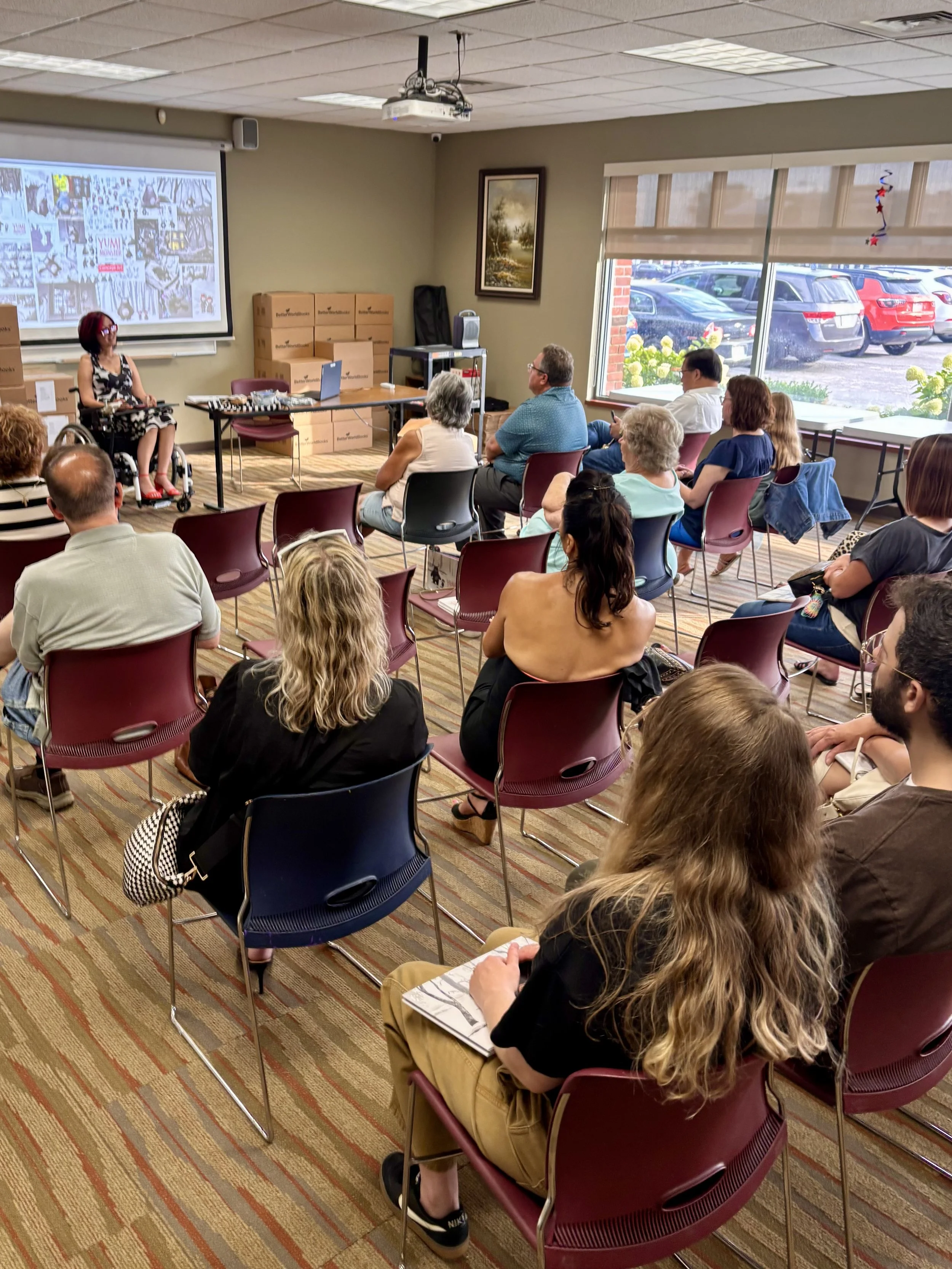
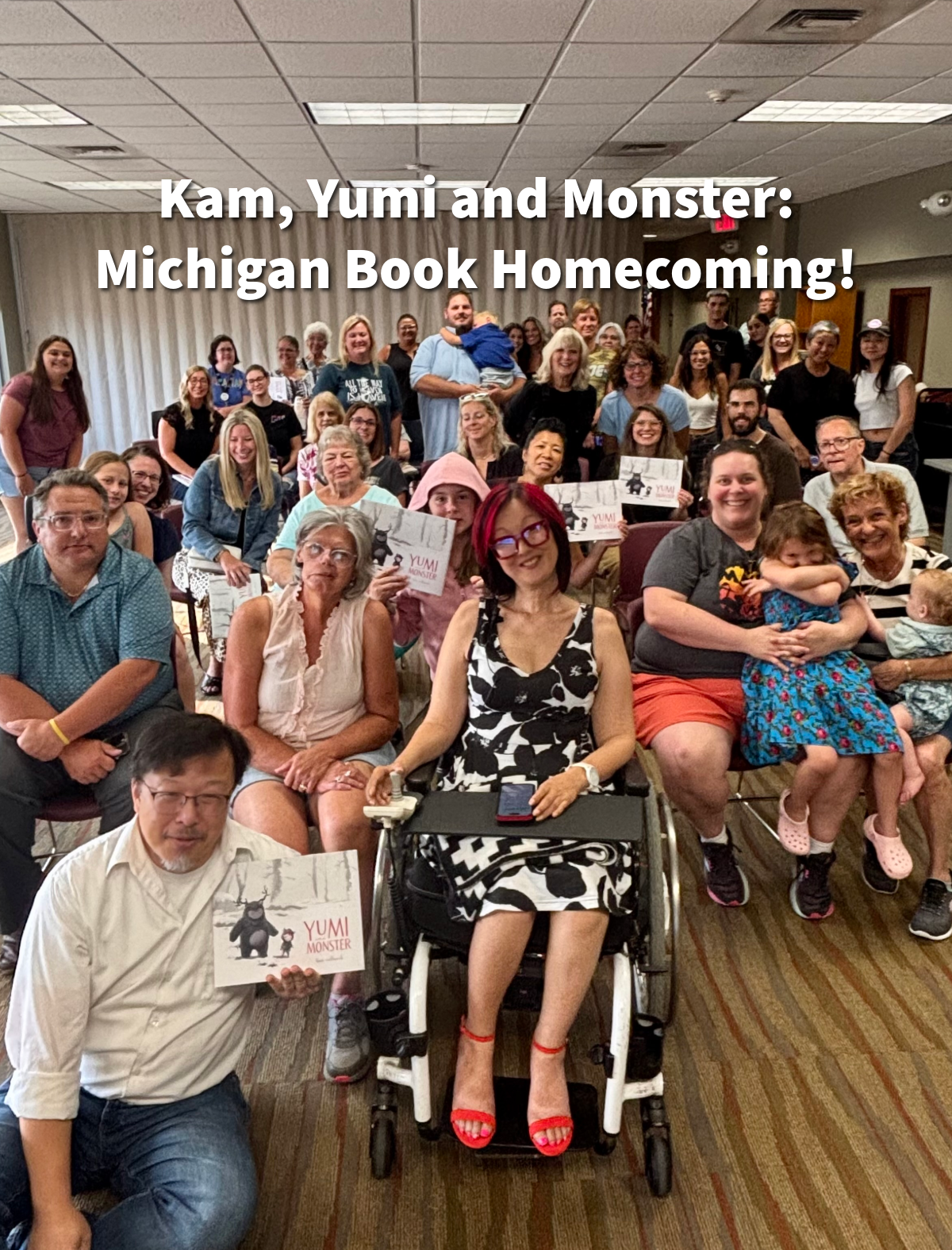
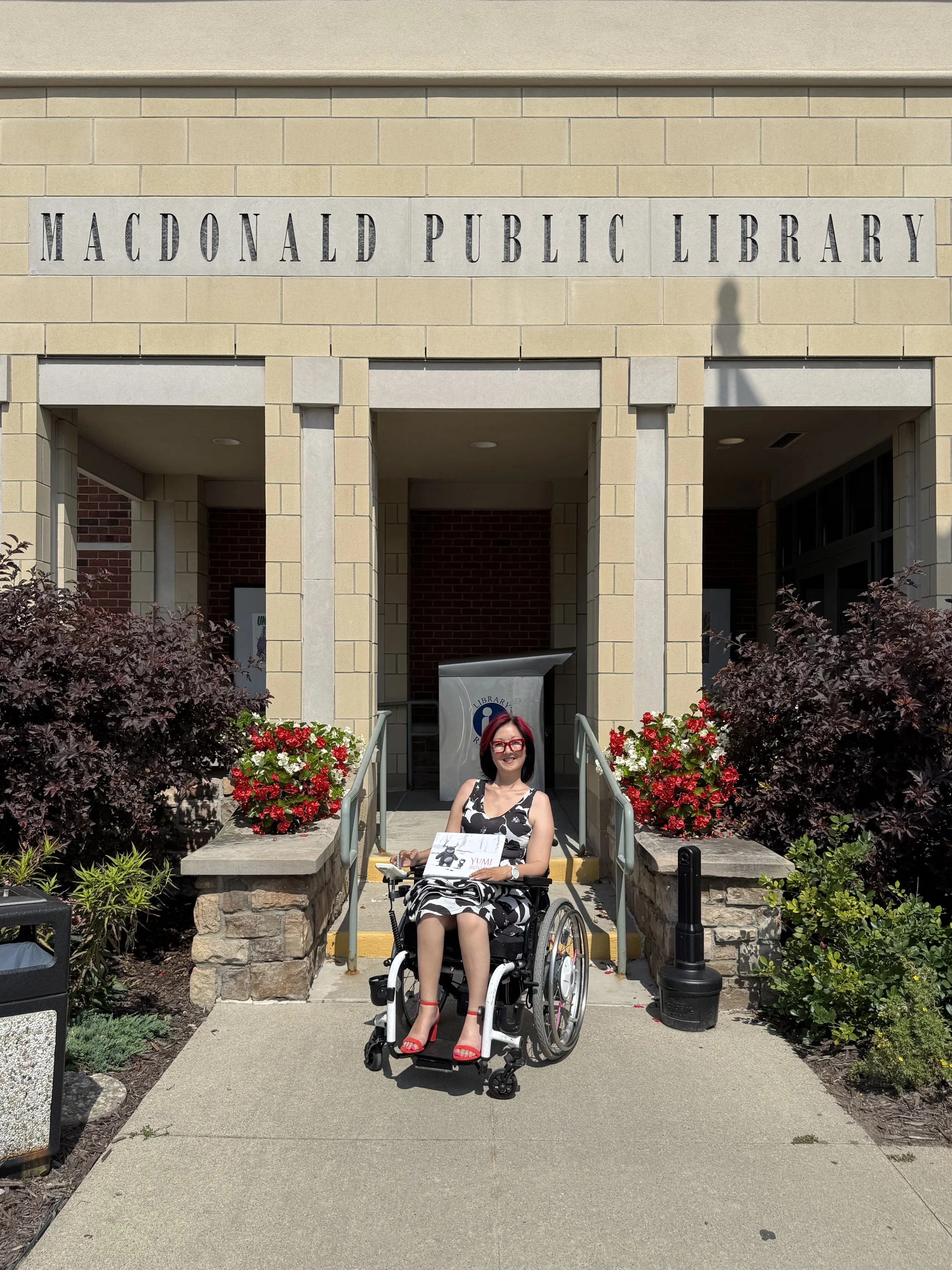
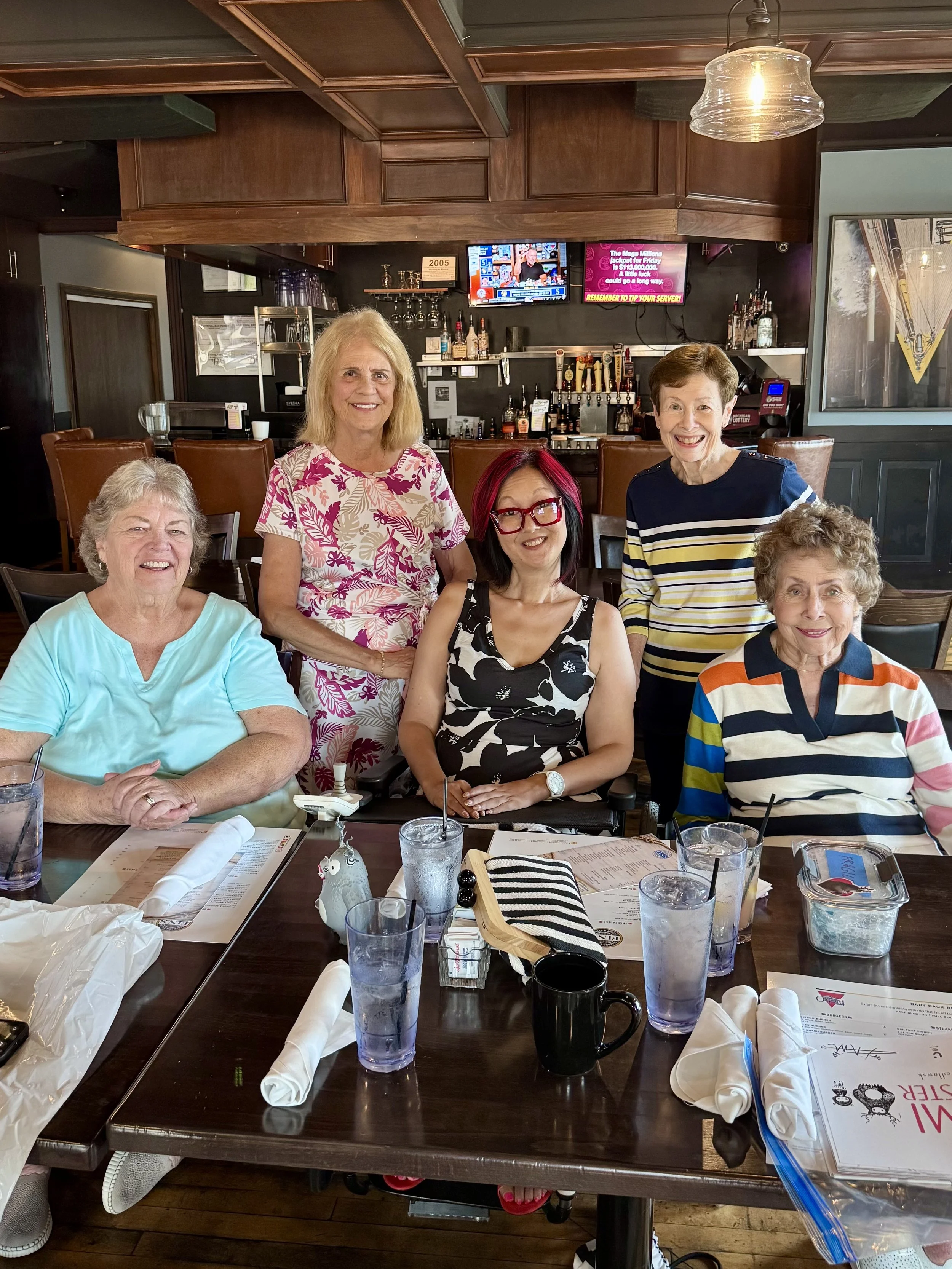
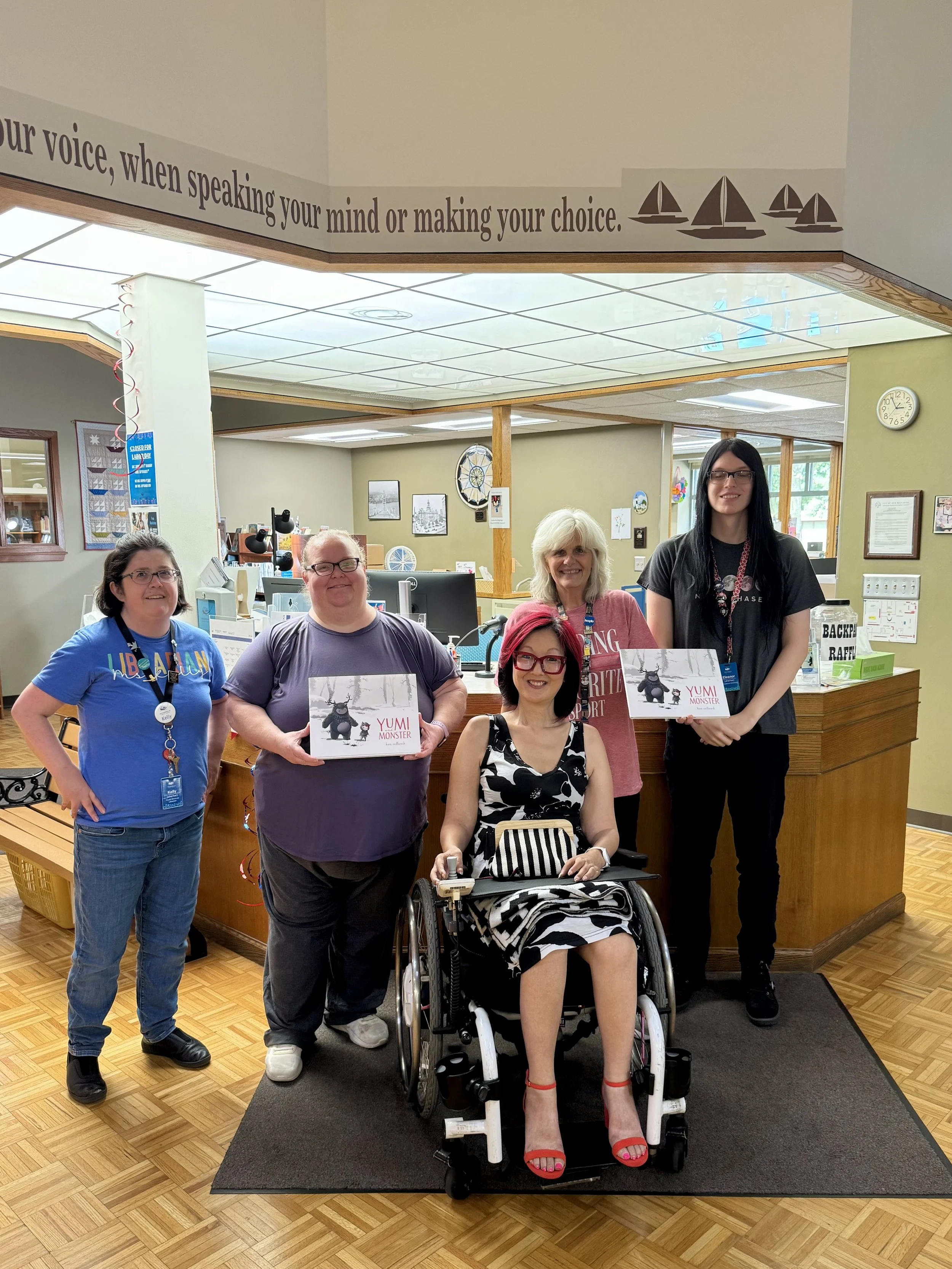
Summer was furiously busy with lots of travel, full of stories I’ve yet to share, including this Yumi and Monster book signing at New Baltimore’s MacDonald Public Library. While I thought it was probably the worst book presentation I’ve done in the past year, nevertheless, it was memorable with some of the attendees in this group shot, and 100 signed copies left in Michigan!
There were multiple reasons for this last-minute trip, so I was surprised so many people showed up on a beautiful Wednesday afternoon, including an Instagram follower friend, Allié, who drove 2 1/2 hours just for an hour presentation so we could meet in person for the first time. I know there were many who wanted to be there, but just couldn't. Just know, the support meant so much. ❣️
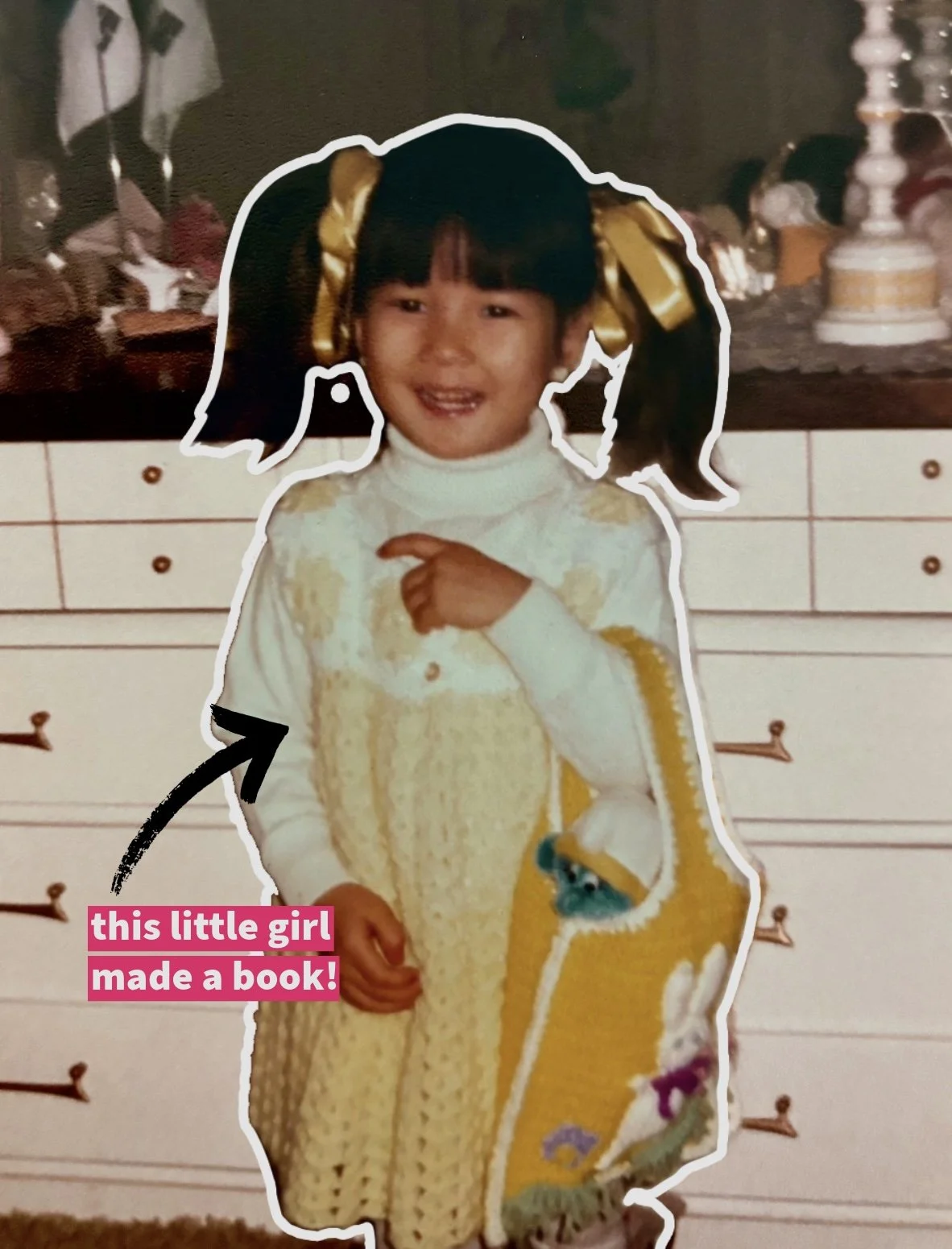
Being amongst the town I grew up in with my first picture book in hand, including childhood classmates and teachers, I still felt like the little five-year-old girl. I feel like this everywhere, really. Aren’t we all just the little child inside trying to figure out our life since birth; past, present, and future?
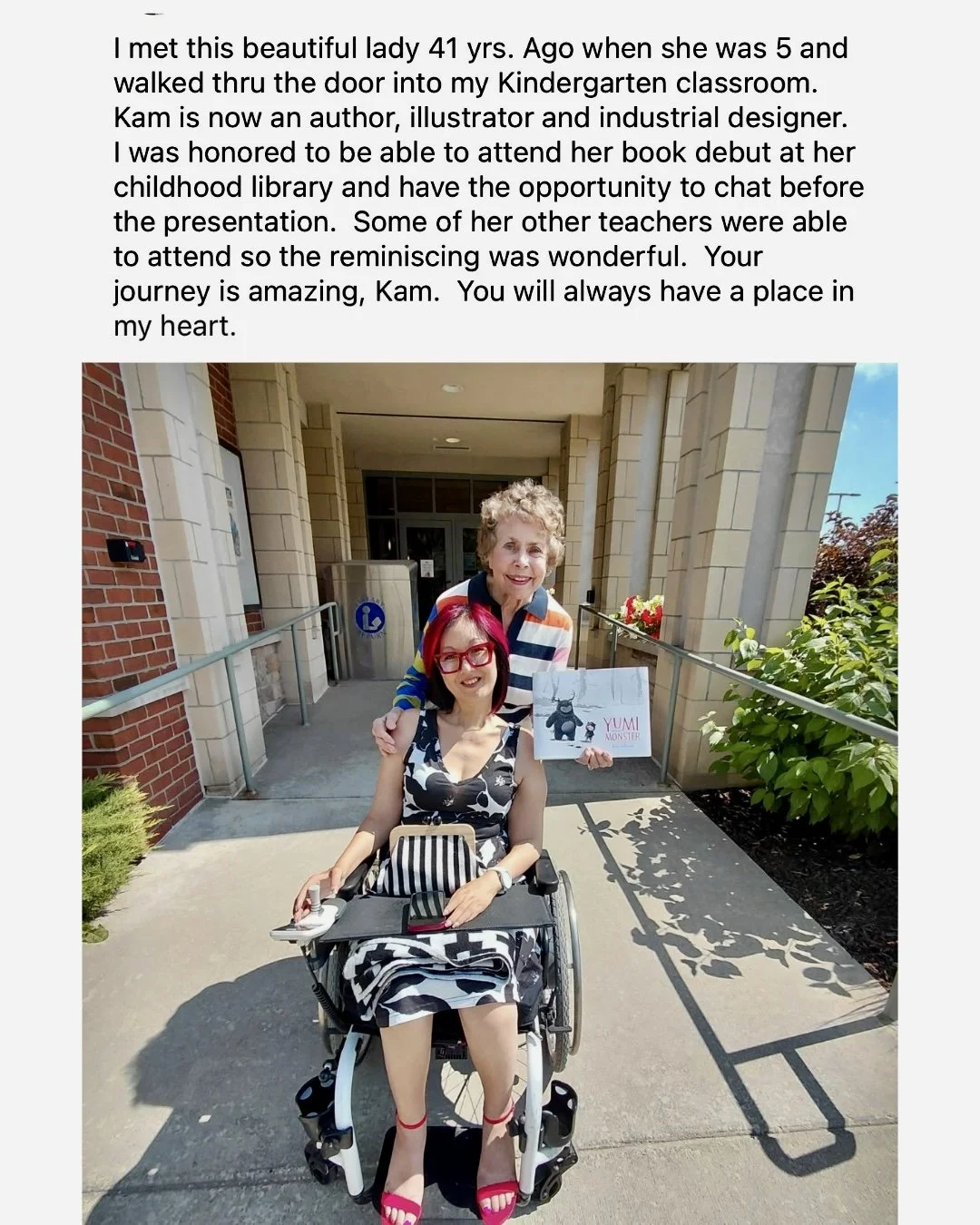
Prior to the book signing, I had a separate lunch with teachers from high school and even preschool. Teachers are such an important part of us, with most of us having fond memories of favorites, so it was special nice to reunite and let them know that I remembered who & what they were. And that it mattered to this little girl. It was wonderful seeing them. Newly arrived in Michigan from Korea, I remember having a sense my elementary teachers (Mrs. Greenlee) and speech pathologist for my cleft palate (Mrs. Campbell) were my advocates, and after hearing stories about me as a kid when I first arrived, I can see why I felt this way.
It was nice to learn about myself from those who knew me when I was little, a number quickly declining over recent years. It’s remarkable how everyone basically had the same memory and sense of me and my character, which greatly contrasts with how I felt about myself back then: smart, kind, and creative.
I think being a kid that was bullied, it was easy to live inward. Much of my world was inside my mind, like today, but more ferociously so due to immobility… Today I understand what “IT” was and is. I didn’t know back then, and in so many ways I don’t think it was understood by my environment.
But speaking of facing bullying, as an adult looking back, it’s nice to hear how you really were, in spite of all the bullying, insecurity, depression, and the confusion of childhood; that you still cared about others, a vulnerable act I constantly berate myself for, then and now. It’s so much easier not to care.
I don’t think I’ve shared that I learned a former junior high classmate I casually knew named her daughter after me (with a “C”) because she said I was kind to her when she transferred to our school. It’s awkward sharing because I don’t want it to come off as bragging, but the point is, I guess it really does matter… It matters how we are.
***
Someone once wrote to me that they think I’m the kind of kindness that has experienced unkindness… Perhaps this is true. All of this bullying talk is not meant to make adults who were once “the bullies” feel bad about themselves. The more important part is to teach our children how to treat people, and much like Yumi, understand how to direct and process our emotions in a healthy way because at the end of the day, while we may think we’re avoiding our emotions and struggles, they’re always there, much like in Yumi and Monster, and when not confronted, it comes out as harm to others or ourselves.
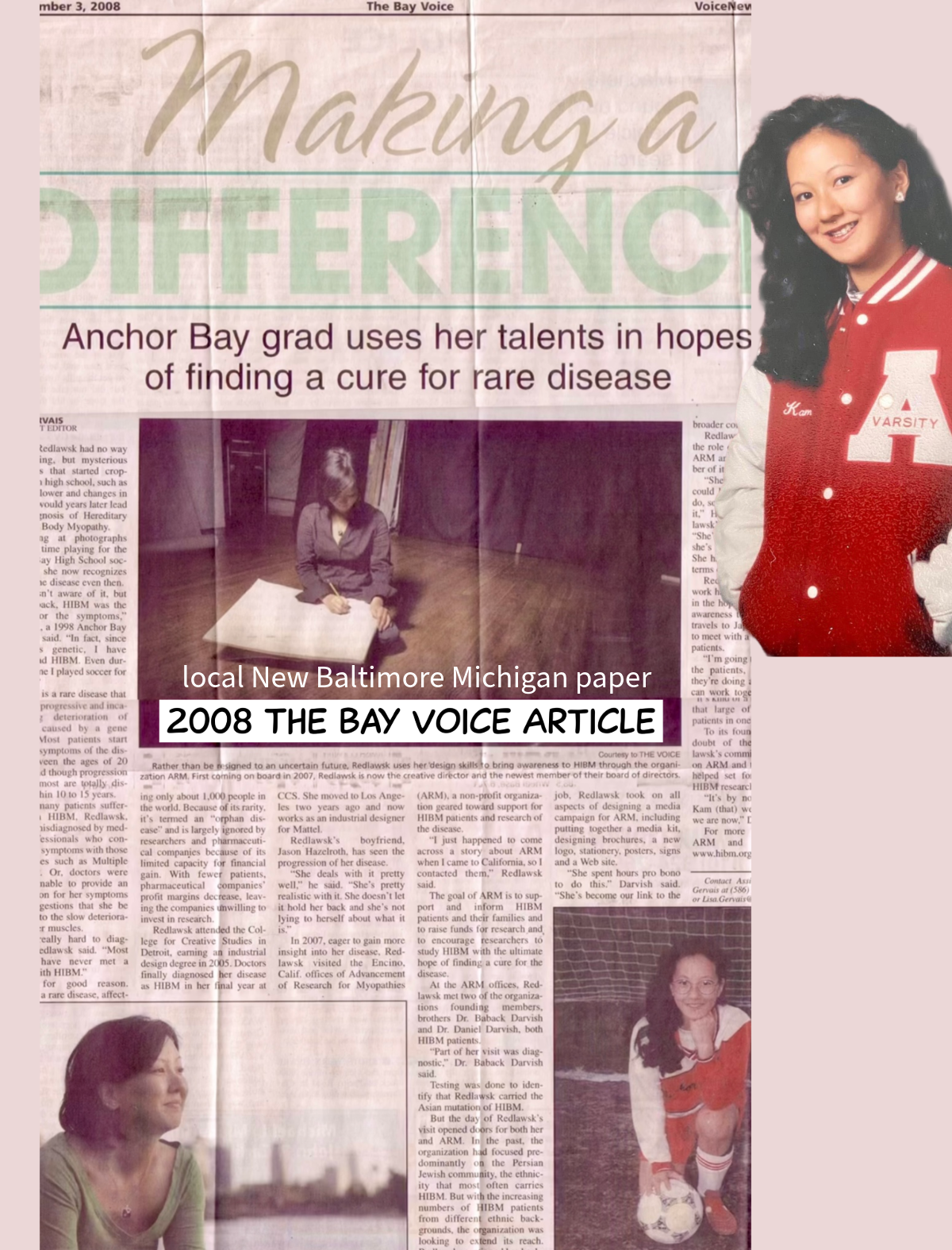
The emotions in Yumi and Monster were in part born from my time growing up in Michigan; a little Yumi, an orphan, adoptee in a new culture, coming of age teenager going through a long, confusing diagnosis roadmap all alone. As a kid, I had so much shame and self-loathing. Childhood was difficult. Fitting in was difficult. Being bullied was difficult. After time passes, you realize that most people had a heck of a time in school, were insecure, and didn’t like themselves, including the popular kids. You also realize that bullies had bullies, a sense I had about mine when I was young.
At the end of the day, when it comes to (high) school, we’re all just thrown into this petri-dish, social experiment, in preparation for potentially a crueler world. If you’re having a hard time, stick it out, it gets better.
Everyone is a genius, but if you judge a fish on its ability to climb a tree, it will live its whole life believing that it is stupid. -Einstein
I love this quote. I use it a lot in presentations.
There were of course so many things I wanted to say on this day of sharing my picture book at my childhood library; about the process of putting together my first book, its themes, and disability that escaped my tongue-tied mind.
Yumi and Monster is really about thinking bigger.
Essentially what I want people to realize is there’s so much more than meets the eye with any change, struggle, or the people we encounter, including disabled.
With so many years passing since school days, many of my attendees were older and dealing with their own stages of aging and disability, reminding us of the undeniable truth that we come and go. At some point, disability will become a part of all of our lives, so it behooves us to contemplate and rethink all we’ve been told when it comes to worth, value, and perceptions, including all the arbitrary rules we’ve been told to live life by instead of according to our own terms.
As a disabled person, it’s common for society to address me in a baby voice, maybe pat my head while holding a public religious ceremony, whether I want it or not, all while congratulating me for the heroism of dragging myself in a wheelchair to a CVS or a grocery store. They have no idea that I’ve lived, seen and done it all from skydiving, to parasailing, scuba diving the great barrier reef, and globetrotting the world as a full-time immobile wheelchair user. *They* assume I’m pitiful, even “worthless” in terms of the perceived inability to contribute nine-to-five to the capitalistic structure; the end and the beginning of what humans have been told is our worth.
The limitations of our imagination and understanding for the people and the world around us annoy me, or rather the inability to be curious enough to want to know what is different from us, not in a position of fear, but greater understanding. It is dehumanizing to experience a society who expects such little of us. You could be an accomplished writer, engineer, artist, scientist, doctor, or a cardiac surgeon in charge of an entire hospital’s cardiac unit that saved lives daily (someone I know) when Parkinson's enters, changing your trajectory, reducing public opinion to focus on your disability, wheelchair, mobility devices, and movements, or lack thereof. We treat the elderly the same.
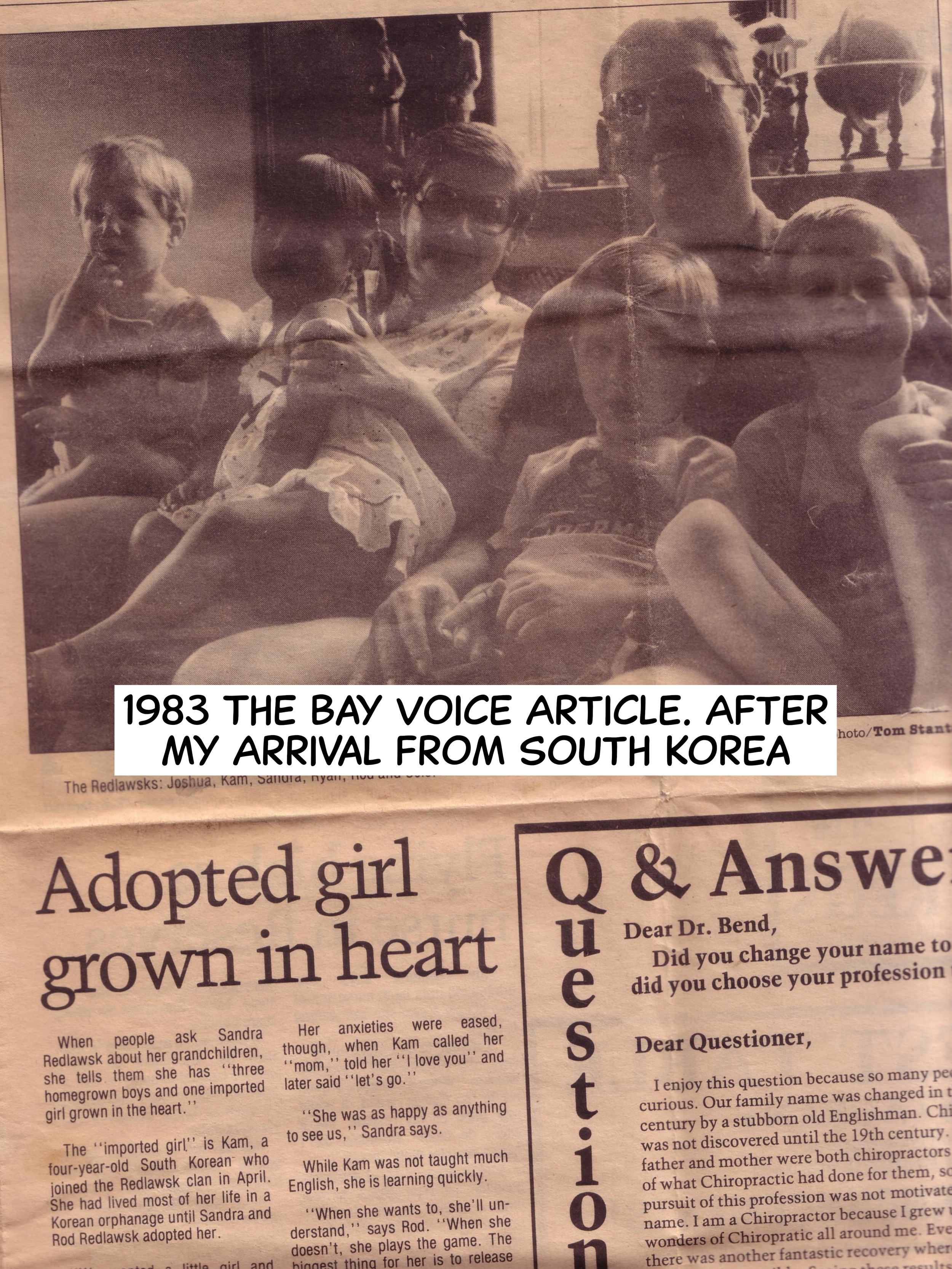
Growing up as an adoptee in an almost all-white environment, it was easy for others to hold archaic stereotypes about me as an Asian immigrant orphan, so I’m used to breaking assumptions. These unfair assertions are because we view life through a very linear and black-and-white lens. We’re not as progressed as we think.
When most people imagine disabled, they think of societal buzzwords like useless, burden, inspiring yet worthless, and entitlement programs. That’s it. This is what we’re reduced to; greedy, lazy, greasy, broken disabled people who live off of entitlements and are better off hidden from society. And yet some of the most historical inventions were created by disabled people, including the fact that it was because they were disabled that these things were invented.
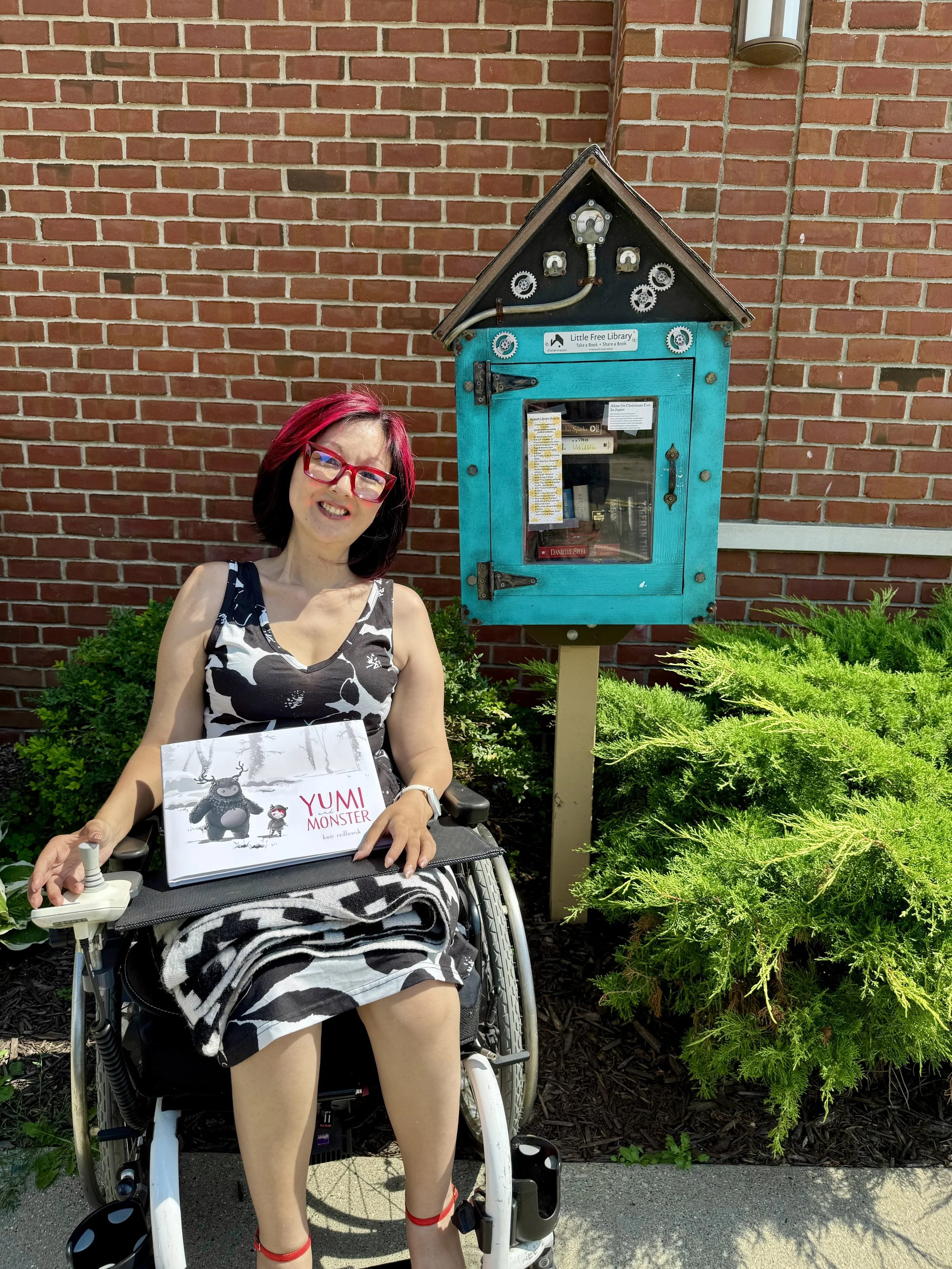
As a disabled person, it’s common for society to address me in a baby voice, maybe pat my head while holding a public religious ceremony, whether I want it or not, all while congratulating me for the heroism of dragging myself in a wheelchair to a CVS or a grocery store. They have no idea that I’ve lived, seen and done it all from skydiving, to parasailing, scuba diving the great barrier reef, and globetrotting the world as a full-time immobile wheelchair user. *They* assume I’m pitiful, even “worthless” in terms of the perceived inability to contribute nine-to-five to the capitalistic structure; the end and the beginning of what humans have been told is our worth.
The limitations of our imagination and understanding for the people and the world around us annoy me, or rather the inability to be curious enough to want to know what is different from us, not in a position of fear, but greater understanding. It is dehumanizing to experience a society who expects such little of us. You could be an accomplished writer, engineer, artist, scientist, doctor, or a cardiac surgeon in charge of an entire hospital’s cardiac unit that saved lives daily (someone I know) when Parkinson's enters, changing your trajectory, reducing public opinion to focus on your disability, wheelchair, mobility devices, and movements, or lack thereof. We treat the elderly the same.
Growing up as an adoptee in an almost all-white environment, it was easy for others to hold archaic stereotypes about me as an Asian immigrant orphan, so I’m used to breaking assumptions. These unfair assertions are because we view life through a very linear and black-and-white lens. We’re not as progressed as we think.
***
When most people imagine disabled, they think of societal buzzwords like useless, burden, inspiring yet worthless, and entitlement programs. That’s it. This is what we’re reduced to; greedy, lazy, greasy, broken disabled people who live off of entitlements and are better off hidden from society. And yet some of the most historical inventions were created by disabled people, including the fact that it was because they were disabled that these things were invented.
For example, most don’t know that texting was pioneered by deaf people through the teletypewriter (TTY) in the 1960s. This allowed typed communications over phone lines. It was designed specifically for and by deaf people. Today, texting is a global part of our culture and arguably something we can’t live without… So every time you’re in a steamy sexting rendezvous or texting your husband to not forget the fabric softener (seriously, forget it, not necessary, all marketing), remember, it’s disabled people that allow you to do this.
Thomas Edison was also deaf; the man who created one of the most prolific technologies of our lifetime, the lightbulb, early motion pictures, and phonographs. He learned to read lips. His wife would also help by tapping translations onto his leg, a form of Morse code.
Walt Disney and Alexander Graham Bell are said to be dyslexic, so when presidents call people with dyslexia dumb, ask them what they’ve done with their life for others in comparison. Beethoven later became deaf but still performed and composed. Einstein, who came up with the theory of relativity, was autistic. So was Mozart, Van Gogh, Beethoven, Tesla, Isaac Newton, Tim Burton, and Alfred Hitchcock.
Then there’s Barbara McClintock’s Nobel Prize-winning discovery of genetic transposition, the idea that genes can move between chromosomes, an idea dismissed for nearly thirty years before the field caught up. Her colleagues couldn’t follow her reasoning because she was operating at a level of visual-spatial detail they couldn’t access. She described being able to “see” the chromosomes as if looking through a microscope even when she wasn’t. “That capacity for intensely granular visual processing is documented in autism research as a cognitive advantage in certain scientific domains”. McClintock’s disability, her differentiating uniqueness, allowed her to see in ways others could not.
This is the point of looking at people individually rather than as a label or group; broad paint brushing everyone as one thing. The mind, and the adventure we take it on, no matter disabled or not, is a beautiful and unpredictable outcome, with every perspective being unique and valid in the grand scale of humanity.
Despite what people say, diversity in species, diversity of experiences, and the way that we see the world, or not see, is in fact our greatest strength. As a designer, it makes perfect sense. When I’m designing a product, I have a certain amount of conditions I’m designing for, such as demographic, costing, and schedule. The more (unique) attributes you add to your design project, such as how a disabled person experiences this, the more ideas you’re likely to cultivate outside the mainstream guise of what we think is possible. And I think that is the word right there. What is possible. There is so much more possible than we think, including it coming from a disabled person.
So instead of viewing disabled people as useless entitlement takers, perhaps a better conversation to be had is the fact that society discriminates against us, especially when it comes to jobs, something I experienced my whole disabled life. Or the fact that the world doesn’t want to be accessible. Perhaps you haven’t seen us in the world because we haven’t been welcomed. Most disabled people don’t want entitlements; they want to be included as part of society and contribute their perspective, but we’re often kept at arm’s length just because we’re disabled.
For example, most don’t know that texting was pioneered by deaf people through the teletypewriter (TTY) in the 1960s. This allowed typed communications over phone lines. It was designed specifically for and by deaf people. Today, texting is a global part of our culture and arguably something we can’t live without… So every time you’re in a steamy sexting rendezvous or texting your husband to not forget the fabric softener (seriously, forget it, not necessary, all marketing), remember, it’s disabled people that allow you to do this.
Thomas Edison was also deaf; the man who created one of the most prolific technologies of our lifetime, the lightbulb, early motion pictures, and phonographs. He learned to read lips. His wife would also help by tapping translations onto his leg, a form of Morse code.
Walt Disney and Alexander Graham Bell are said to be dyslexic, so when presidents call people with dyslexia dumb, ask them what they’ve done with their life for others in comparison. Beethoven later became deaf but still performed and composed. Einstein, who came up with the theory of relativity, was autistic. So was Mozart, Van Gogh, Beethoven, Tesla, Isaac Newton, Tim Burton, and Alfred Hitchcock.
Then there’s Barbara McClintock’s Nobel Prize-winning discovery of genetic transposition, the idea that genes can move between chromosomes, an idea dismissed for nearly thirty years before the field caught up. Her colleagues couldn’t follow her reasoning because she was operating at a level of visual-spatial detail they couldn’t access. She described being able to “see” the chromosomes as if looking through a microscope even when she wasn’t. “That capacity for intensely granular visual processing is documented in autism research as a cognitive advantage in certain scientific domains”. McClintock’s disability, her differentiating uniqueness, allowed her to see in ways others could not.
This is the point of looking at people individually rather than as a label or group; broad paint brushing everyone as one thing. The mind, and the adventure we take it on, no matter disabled or not, is a beautiful and unpredictable outcome, with every perspective being unique and valid in the grand scale of humanity.
Despite what people say, diversity in species, diversity of experiences, and the way that we see the world, or not see, is in fact our greatest strength. As a designer, it makes perfect sense. When I’m designing a product, I have a certain amount of conditions I’m designing for, such as demographic, costing, and schedule. The more (unique) attributes you add to your design project, such as how a disabled person experiences this, the more ideas you’re likely to cultivate outside the mainstream guise of what we think is possible. And I think that is the word right there. What is possible. There is so much more possible than we think, including it coming from a disabled person.
So instead of viewing disabled people as useless entitlement takers, perhaps a better conversation to be had is the fact that society discriminates against us, especially when it comes to jobs, something I experienced my whole disabled life. Or the fact that the world doesn’t want to be accessible. Perhaps you haven’t seen us in the world because we haven’t been welcomed. Most disabled people don’t want entitlements; they want to be included as part of society and contribute their perspective, but we’re often kept at arm’s length just because we’re disabled.
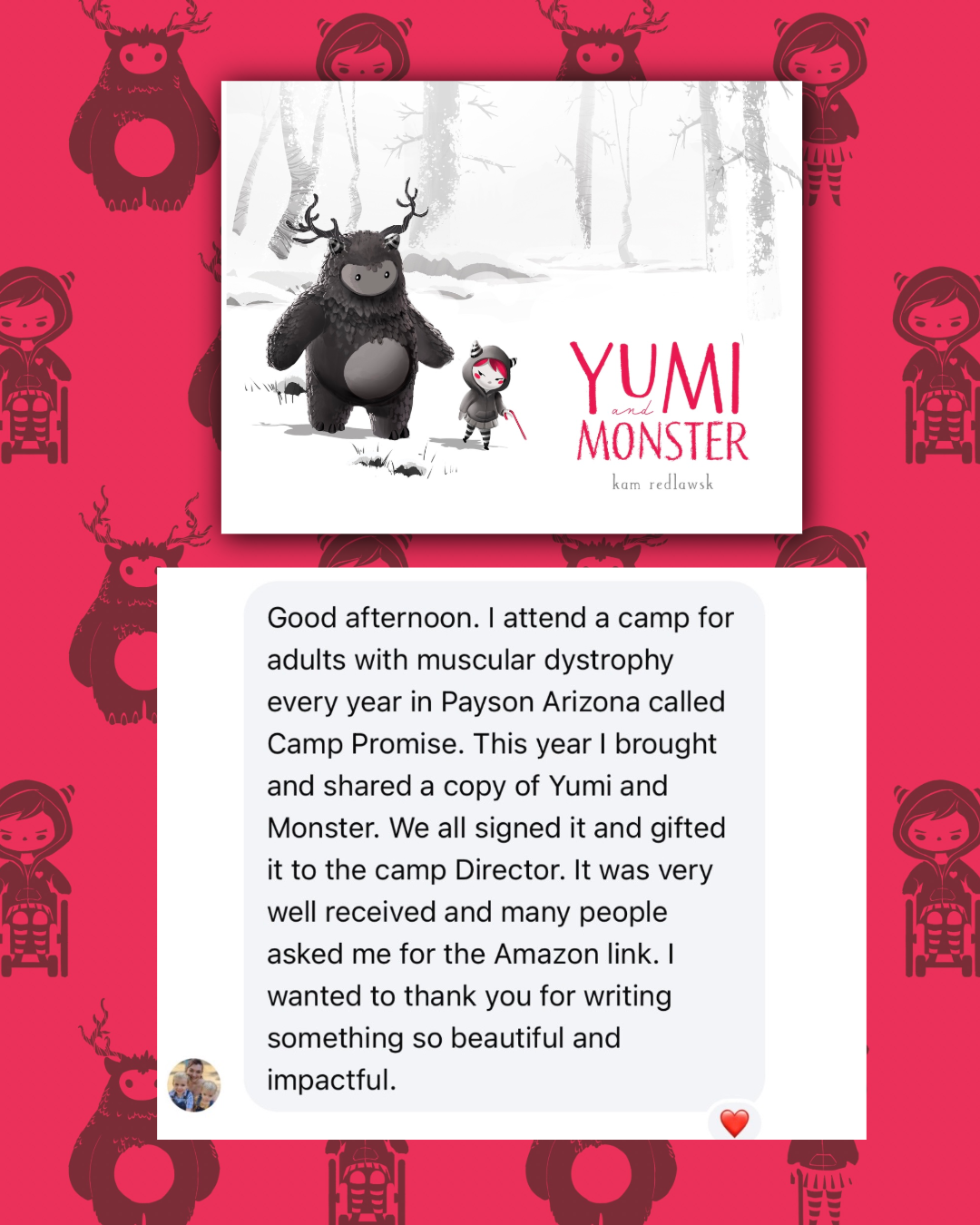
Most of all… With Yumi and Monster, the biggest message is I want people to be OK with themselves. Life can be difficult, swallowing us whole. This is even harder when we can’t see the good in ourselves just as we are in all of life’s undulating ways.
What Yumi has to discover is her own interpersonal relationship with herself, the most important one she’ll ever have, and all the changes that come into her life, namely, her disability, but also the importance of confronting our emotions, and that they’re not something to be ashamed of… that we are not something to be ashamed of.
Shame hides in so many lives, but like Yumi has to come to understand, she is who she is because of her individual journey. I don't think we have to be grateful for cancer, illness, disability, or traumatic events, or even think it was placed into our lives to “teach us a lesson”. Doesn’t it go without saying that all of us technically need to be taught a lesson, and that in general, our entire life is one? Why does a mother across the world watching her child be bombed need to be taught a lesson anymore than anyone else? I think it’s OK to be honest about our real feelings about illness, disability, and struggles: we don’t have to love them and be grateful for them, but we can see that it is a part of our story, and that we’re worthy of love. To me, this is enough of a miracle, how different we all truly are, and yet the same.
For myself, I can’t tell you how indelibly grateful I am for how my life has transpired, namely, that creativity has always been at the epicenter of it, whether I knew it or not. Creativity has been the wind and sails through this grievous journey of living with a progressive and rare form of muscular dystrophy. While I’m not a believer in comparing what could’ve been, because nobody can know if a different path would’ve been better, it turns out my hasty decision to turn down two full-ride college scholarships In exchange for an art school, college loans, and a major I never heard of worked out.
For much of my life, acting on (com)passionate impulse and saying yes has been a friend of mine. Creativity and curiosity have literally saved my life, and remnants of this live inside the modern fairytale Yumi and Monster. I think at the end of the day, what is more important than mobility and intellect is perseverance and the ability to adapt to the changing winds because as much control as we think we might have, including those with immense power and wealth, the fact of the matter is, we’re all going there: towards disability, aging, and death, so what do we really want to do in between these points in time?
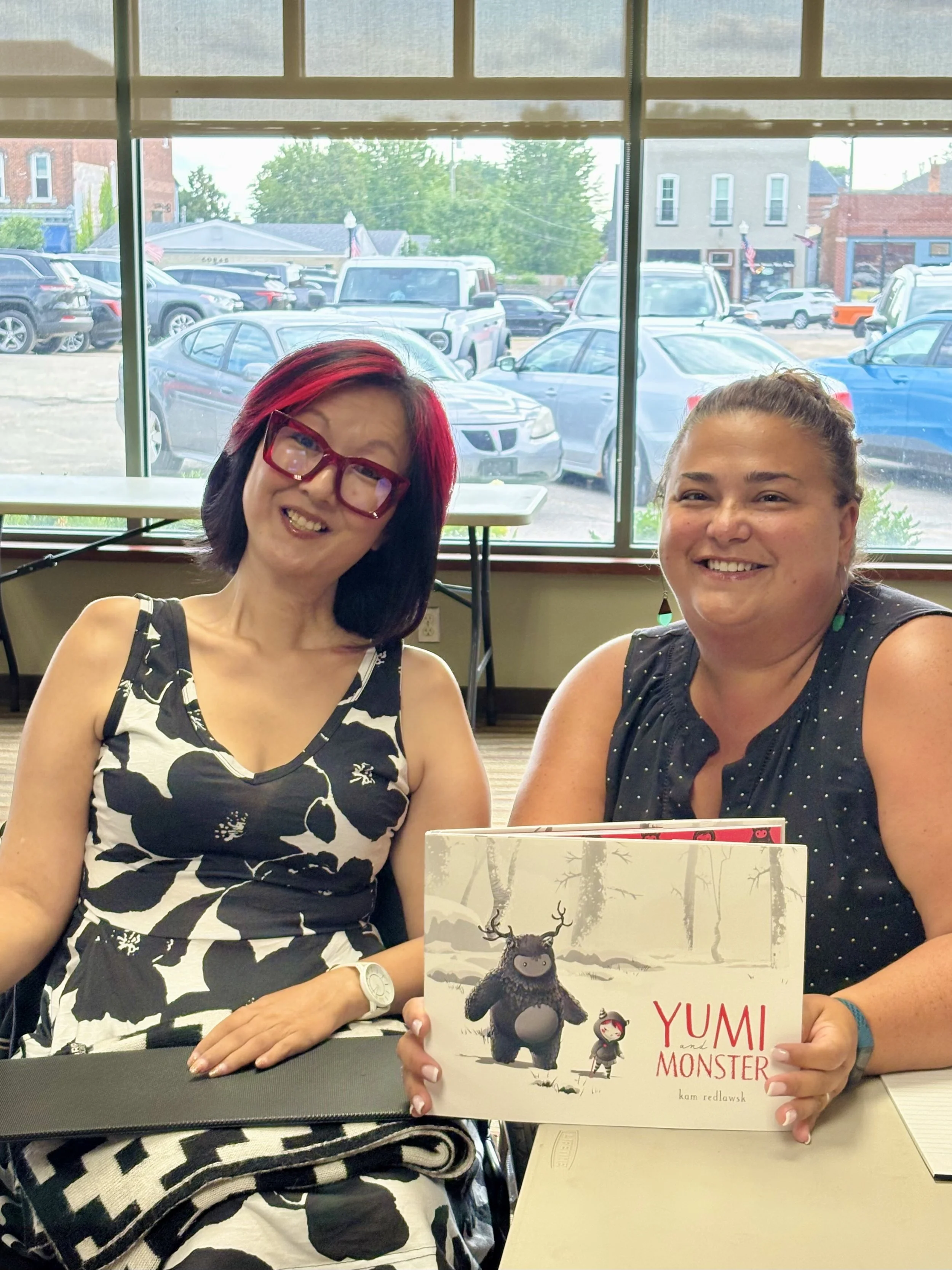
It was truly wonderful to share Yumi and Monster with my hometown. Thank you so much for coming and support and love through the years! Like Yumi and Monster: explore yourself, explore the people and world around you. This doesn’t have to look like global travel; it could be exploring your own backyard. It’s amazing how many people have never visited the city next to them. Explore new ideas and all the ways one can live, whether you agree or not. Take chances, explore knowledge and learning, for yourself. I know we’re in the age of AI, and it’s so much easier not to want to learn, but honestly, I find learning to be an amazing experience. You can explore so many worlds by absorbing ideas that are different from your way of living and thinking, sensing the internal growth.
Speaking of exploring ideas, at the end of my presentation, I pointed out MacDonald’s librarians like Kelly to thank them for hosting us, as well as the need to support public libraries, especially in these times. I think I saw Kelly tear up. If you don’t know, since January 2025, libraries have been facing struggles, defunding, attacks, and book bans by the federal government. Libraries are important to communities, so keep them going. My school library got me through my childhood; I spent a lot of time there hiding from everything I didn’t understand about (high) school.
Thanks to MacDonald Public Library and Anjie, a sweet classmate I used to play high school soccer with, who helped me set up for last-minute. Thanks, Michigan! I love you; if there’s one takeaway from wherever it may be, let it be to foster your emotions and care about what happens to others.
Watch Yumi and Monster’s book year in 5-min. recap on my Instagram at: https://www.instagram.com/reel/DduBx2CvXAI/?exln=NTc4MTIwNjQ2YQ==
Part 2 of this post, “Part 2 / “Leong’s Childhood Takeout”, coming up next.
Read/share this post, “Part 1 / Kam, Yumi, and Monster’s Michigan Book Homecoming” link in bio at: @kamredlawsk.
*After I share a few summer throwback stories, I’ll be doing less IG posting as I work on my next big project. Stay tuned. Oh, and no AI was used in writing this or any of my writing… just me and the last two working fingers I have left. Feel free to support my work by sharing, it helps & encourages me.